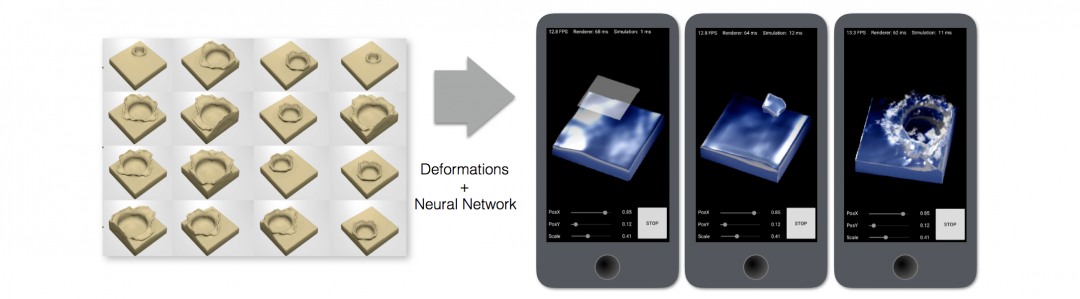
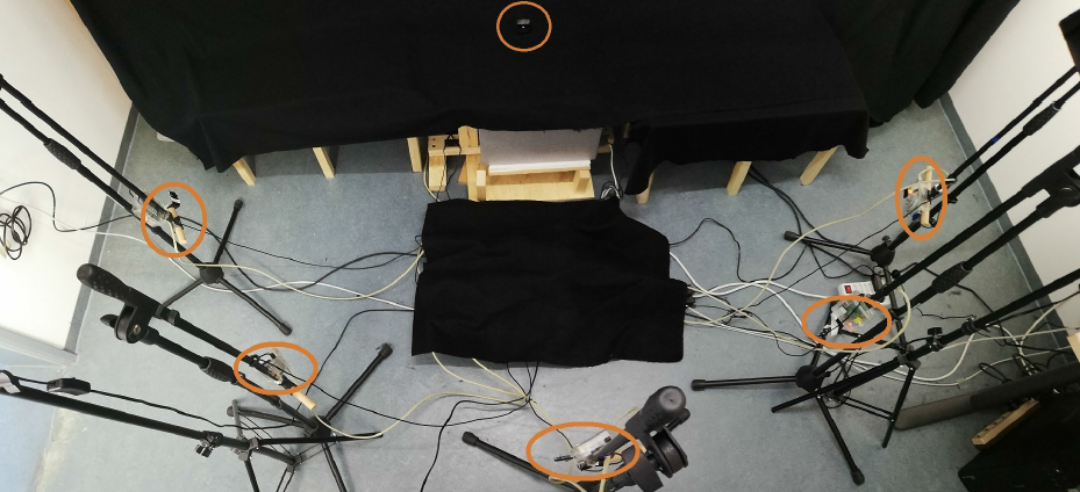

The new version of mantaflow is online! mantaflow is our open-source framework targeted at fluid simulation research in Computer Graphics. We’re especially working on making mantaflow a convenient platform for fluids and deep learning. The new release contains a first set of tools and examples to get started. We will post more in-depths tutorials here in the coming weeks.
In addition, the new release supports surface tension forces, e.g., for simulating small droplets, and a viscosity solve for thicker materials and physically more accurate simulations. The fast multigrid solver is another highlight. It allows for efficient calculations of large-scale effects.
Here’s an incomplete feature list:
- multigrid-preconditioned solver
- Eulerian simulation using MAC Grids, PCG pressure solver and MacCormack advection
- Flexible particle systems
- FLIP simulations for liquids
- Surface mesh tracking
- Free surface simulations with levelsets, fast marching
- Wavelet and surface turbulence
- K-epsilon turbulence modeling and synthesis
- Maya and Blender export for rendering
- tensorflow couping via numpy arrays
Btw., mantaflow has been used in numerous publications! Among others:
- Data-Driven Synthesis of Smoke Flows with Convolutional-Neural-Network-based Feature Descriptors, SIGGRAPH 2017
- Interpolations of Smoke and Liquid Simulation, Transactions on Graphics 2016
- Narrow-band FLIP, Eurographics 2016
- Surface Turbulence for Particle-Based Liquid Simulations, SIGGRAPH Asia 2015
- Connecting Forward and Inverse Problems in Fluids, SIGGRAPH 2014
- Liquid Surface Tracking with Error Compensation, SIGGRAPH 2013
- Turbulent fluids: Course, SIGGRAPH 2013
- Lagrangian Vortex Sheets for Fluid Animation, SIGGRAPH 2012
- Physics-Inspired Topology Changes for Thin Fluid Features, SIGGRAPH 2010
- A Multiscale Approach to Mesh-based Surface Tension flows, SIGGRAPH 2010
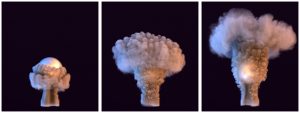
Fig. 1: A few images of a controlled smoke simulation using the PD-guiding feature of mantaflow.